
Scraping a motorcycle footpeg in a corner may look impressive, but it isn’t always safe. This motorcycle riding tip will help you avoid a potentially life-threatening danger that many riders overlook.
Most of us don’t need to ride on the limit. However, one day you might find yourself leaning your motorcycle too far into a corner and hear or feel the footpeg scraping against the asphalt. What should you do in that situation?
First, let’s look at what I believe most motorcyclists would instinctively do, and why it can be extremely dangerous.
They would immediately roll off the throttle and reduce the motorcycle’s lean angle. Both reactions can be mistakes.Rolling off the throttle can destabilize the motorcycle and cause a fall, while trying to reduce the lean angle incorrectly can make the situation worse. If the footpeg digs into the road, it may catch on the asphalt rather than simply scrape across it.
There are three actions you can take if you hear or feel your motorcycle footpeg scraping the road:
1. Apply more throttle. Be aware that you may already be close to losing control, and ANY increase in speed could put you in a situation where recovery is no longer possible. This is an EXTREMELY DANGEROUS option. The idea is that acceleration can help raise the motorcycle, but it can also increase the lean angle depending on the turn and your riding inputs. If everything goes well, the footpeg will quickly gain ground clearance.
2. Countersteer away from the side of the scraping footpeg. This increases the turning radius, allowing the motorcycle to follow a wider line through the corner.
3. Shift your body weight toward the side of the scraping footpeg. Yes, you read that correctly!
Each of these actions can help bring the motorcycle more upright and address the problem. Any one of them may help on its own, and you can also combine two or all three when appropriate.

Important: Opening the throttle to increase ground clearance produces only a VERY SHORT-LIVED EFFECT in some situations. As the motorcycle accelerates and its lean angle increases, the additional clearance can quickly disappear, potentially increasing the force with which the footpeg contacts the road.
Throttle control is undoubtedly especially important at very low speeds. At higher speeds, using the throttle to achieve the same effect becomes even more complicated. Earlier, I mentioned that throttle control alone might appear sufficient to address this problem, but in practice, countersteering and widening your line may also be necessary.
I want to emphasize that, in my opinion, the wrong reactions are instinctive for many riders. That is why it is important to prepare mentally and understand how to respond before you find yourself in this situation.
That is precisely why you are reading this motorcycle riding tip: to learn from other people’s experiences rather than your own, and to avoid making potentially fatal mistakes.
Why Shifting Your Body Weight Can Help Prevent a Footpeg Strike
Let’s take a closer look at the third action, as I believe it is the best option to consider.
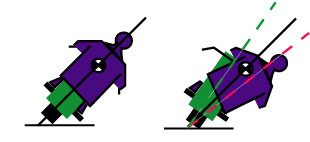
The illustration below shows two scenarios. On the left, a motorcycle is leaning into a corner with its footpeg touching the road. On the right, the rider has shifted their body toward the inside of the turn, allowing the motorcycle to become more upright so that the footpeg no longer touches the road.
Author: James R. Davis